Eat me

food-3   food-1 food-2   food-4

 food-5    food-6   food-12

    food-7   food-11  food-10    food-9

It’s the last thing you might want to do to these, but hell, they sure are something to look at!

These plates(!) from a cook book from yore that was found in a flea market in Brussels, set a standard in food preparation that leaves me awe struck.

Duck is served in a pond accompanied by a flotilla of her young. What on earth can the ducklings be made of? Sea food served up in a symbolic heart? A salad clock? Fish in livery? A clog cake? How about an omelette embellished with encrusted symmetrical swirls? Is this the same foodstuff that I plopped from the pan onto a plate as flat as the proverbial pancake and cut into the rough shape of a face to encourage a fussy toddler to eat ? That’s the closest I’ve ever come to the pictorial food arts on display here. OK, that and a few amateur birthday cakes. Many started with a theme such as boat or train or caterpillar but fell into the family speciality volcano because of a few problems with consistency.

I love these images. Gaudy and unappetising they might be, but they warm the heart. A++ for effort and care from cooks and illustrators. Compare them to images from contemporary cookbooks where the natural look (as unattainable, in fact) is all the vogue. Rather insipid, actually.

Eat your heart out food stylists of the day.

Posted in Art commentary, food | Tagged , | Leave a comment

Guest Spot 1: Gerald Prinsloo

Gerald 

Gerald works for us every 2nd Saturday, doing a bit of gardening, painting, that sort of thing. I asked him permission to publish what he has told me of his life.

In his own words:

I’m Prinsloo because I was adopted by my grandparents, my grandfather was Andries, something, something Prinsloo. I was with them from when I was 6 months when my parents were separated. My mother had a struggling life. She had 2 other daughters, my sisters, Patricia and Carol. I don’t see them too often, maybe I saw them a year and a half ago. Patricia is married and has 3 daughters and Carol has 3 sons but one died in a road accident after matric. He was coming back from Suldhana from the navy.

I went to Zwaanswyk Primary school and after that trade school, Batavia until three-quarters of Std 7, then I had to leave school for certain reasons. I worked on the railways in Salt River close to a year. When I was working there, I had to leave and they paid me off because of the eye incident which affected me both mentally and physically.

I was stabbed with a broken beer glass. First I was kicked, then stabbed in the wrist and then in the eye. I was 17. They stitched the eye up at Victoria Hospital but when I was 33 the doctor said it had to be removed. Until then I was on many tablets.

I never married, life has its odds and ends for certain people. I carry on, I can’t worry about things like that. I haven’t found anybody suitable. It’s not a killer, as long as you keep busy and look after yourself.

I stay in Kalk Bay. The owner, a lady, lives on top. I have a room below right on the main road. You can never get rid of all that noise from the traffic all night through and on the weekends.

I prefer to walk to the cafe in Fish Hoek, then I leave my bicycle at home in my room. It’s better exercise. When you walk you take your whole body with you. Most of the time I am by myself but I do greet people on the road here and there and keep myself busy.

I’m 60 now. Before when I was a youngster, I’d go swimming at St James either in the pool or behind it in the sea. I used to fish, rock angling, and I helped with trekking fish.

These days I don’t go to church. A person, how can I say, must still believe in God. You as a person, are not your own saviour, your own destiny. You need someone in case of different things to look up to, ja, definitely, you got to believe.You’ve got to look after yourself for God to look after you. For instance, I’ve stopped smoking for 4 months now and I don’t worry about drinking.

I won’t say I wasn’t a naughty boy. I took part in things that people take part in today, like I went to discos, had a drink myself, things like that. Elke mens moet sy eie kop stamp. When you are young, you have to learn yourself, the hard way, when you are using drink and smoke.

This is the story of a person. I’m telling the truth. I’m not full of crap like that, I wouldn’t put a finger in someone’s eye, never mind a beer glass.

Posted in Guest Spots, People | Tagged , | Leave a comment

Ugly

It’s a lesson that I keep having to learn over and over again. Ugly doesn’t matter.

When all the instincts scream, “too hideous for words,” the strategies kick in:

Destroy it: Before my eldest son was born I gouged a hole into headboard of a brand new wooden cot to remove a stubborn decal of a hideous Disney type creature that I decided would  pollute his pure, unspoiled perception. I was restrained from doing the same damage to the other end of the cot. Needless to say, the remaining decal was the first image that cracked a smile and brought  a coo from the fractious fiendish baby.

Banish it: I made Peter help me carry pieces of heavy, I mean HEAVY, imbuia ball and claw furniture up three flights of stairs to store it out of sight so that our little rent controlled flat in Sea Point would be to my liking. We lived in fear of the landlord forcing his way past us when he came to the door knowing he would be livid on discovering the excellent furniture that was meticulously itemised in the lease was nowhere in sight.

Avoid it: An acquaintance once told me that he could not send his child to a particular school because it was so ugly. He meant the buildings, the setting, and my God, there are some ugly schools around, that is for sure.

Ignore it: My best friend, sadly gone now, loved those cheap screaming scarves with dolphins or sunsets soaked into synthetic swirls. She would drape them over her hips or shoulders, over lampshades and sofas. When in her wonderful company I would silently go through a list of all the awful people I had met with impeccable taste.

Make it beautiful: What was drek decades ago, is cool today. Retro is a category that moves inexorably forward, skipping the immediate past and embracing everything that trails behind it, bathing it in nostalgic beauty.

Make it a mission: For years I attempted to stretch my aesthetic to include ugly, clumsy, unpolished till it became the banner of contemporary painting: Bad painting had become good painting. Now, bad painting is once again bad and I am faced with the opposite pole  –  smooth creepy stuff that I am physically allergic to. I have to stop myself from dismissing it as ugly right away. I work hard at ingesting it and turning it beautiful. Many times I do not succeed.

Empathise with it: Feel for the ugly. Twenty years ago an acquaintance told me, “You’re not much to look at but you’ve got personality.” It’s the kind of comment that sticks with you because although you wish the first part were otherwise, you know it’s true. It also gives you great empathy with all the other ugly people in the world and by extension, funny as it must sound, objects too. It’s not my fault, screams the house next door, I was made that way.

Live with it: Here is our back door. Like some kind of giant orthodontic work, it is embellished with the window/door dressing that SA loves best.

 IMG_6163 

These were once very pretty French doors. They are the very same doors that were smashed to smithereens as intruders entered our home late one night, held a gun to my dear husband’s head and kicked him about. Three weeks later he had a heart attack.

Now, that’s ugly.

Posted in issues | Tagged , | Leave a comment

It’s not only high art that speaks

                                                 image-90-blog-4

Maybe by now you’ve realised that we are – you name it – junk addicts, flea-market trawlers , fête bingers, rubbish luggers… How about collectors of crappola (a term coined by another shit magnet and great American artist, Philip Guston)?

One of my latest finds is this painting of a lady reading a book, obviously by an amateur artist. The initials and date in the corner are G.D. 1957. Decidedly old-fashioned and conservative ( compare it to Jackson Pollock’s works of the same time!), pleasing no one but himself and perhaps his sitter, without a shred of self-awareness, G.D., the Sunday painter, tackled his subject in a bubble of who-cares ignorance. For me the cheap, chipped plaster frame and slightly unpleasant paint application (saving paint?), even the ultimate mediocrity of the work, does not detract from its charm. But I see in it something more, something that urged me to come up with a R100 note for the vendor and bring it home to hang above the mantelpiece…

What is it? There is no reason to delve into what it tells us about making art or its formal qualities for these are minimal or non-existent . The subject. A woman simply reading a book – not a bible which would have given the whole work a undesirable ‘holy ‘ dimension and brought into play a rather sickly association with the yellow light behind her. Nostalgia elicited by the Penguin book cover is a factor. (And they have reissued those covers: light blue for big ideas, green for mystery, orange for fantastic fiction, pink for distant lands, dark blue for real lives, purple for viewpoints.) The shabby cotton dress, thickish neck, straight back, unadorned face and neat almost prim hair endears the sitter to me. It is obvious that G.D. has posed her with a book – a good position for a long session – and asked her to look at the page for the sake of authenticity, and she has done it, this compliant, good-natured soul.

But then – this is where I might be getting fanciful – I just can’t help believing that the mystery book’s magic has started to work and that she has begun to fall into the story she is pretending to read. There is a hint, the barest indication that she is on the verge of shrugging off that self-conscious awareness of posing. Perhaps it’s in the expression on her face or the flush of blood in the arms or the mute expressiveness of the hands holding the book, functional, plain, but beautiful. (Crazy, but Piero della Francesca comes to mind) Another mad leap this, but is there a subtle allusion to the content of the book in the shadowy mass on the left? Straight from the book, through G.D.’s subconscious mind, a form begins to emerge…

I have come to the reason I think I am so enchanted by this simple painting: the delicate tension between the world we are spatially in (where we present our social face to the world, do our hair, dress, sit decorously, pick up a book) and the ability of books to at any time take us away.

Posted in Art commentary, Flea market finds | Tagged , , | Leave a comment

Fantasies of living in a church in Klaarstroom

                                        image-88-blog-3

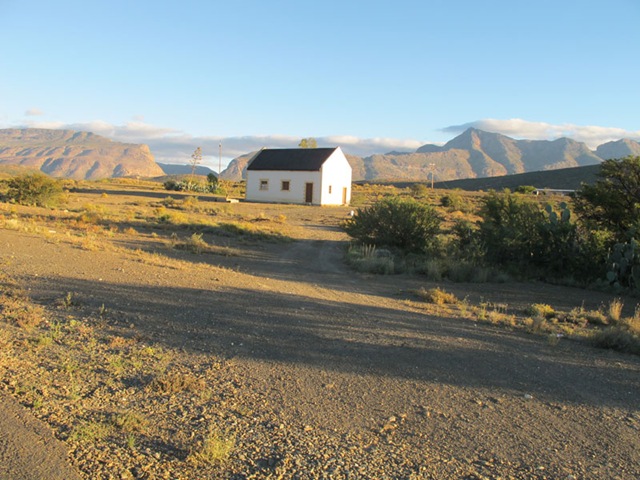
We came across a FOR SALE sign on this bleak, isolated building in the middle of nowhere (which, like most places that are nowhere, is, of course, somewhere -in the small dorpie of Klaarstroom in the Klein Karoo, in fact). An invitation to turn off the road, get out the car and peer in through the dusty windows on tiptoe was naturally taken up by this serial dreamer of alternative lives. It was only after having a really good look round that we realised it was a church, so modest was the building. Inside, there was a wooden “bimah” on one end of the room – I resort to terminology that reveals my inadequacies in these regards – and a small cross of stones above a doorway on a façade that did not face the road.

Immediately, I started to dream…of moving in, of starting a children’s writing weekend programme there, of planting trees to provide shade – but which type of tree? Already this was a dilemma – of inviting friends to stay with us as work parties to help with garden and refurbishment – but which friends? – of writing a book there, of living there forever in the lee of those beautiful mountains.

Then, the B and B owner told us the story of how the church got to be on the market. It seems as if the church used to belong to the Coloured community which, in the typical inherited South African pattern, lives to one side of the village. A doctor who owned a house in the “white part’ of the village witnessed the trek of the Coloured community as they made their way across the town to their church on Sundays and had an idea. He offered to build the community a church at their own end of town, in exchange for the old building. According to the person who told us this tale, he did deliver a perfectly adequate, though basic, structure. But, it was not long after taking ownership of the old church, that it was placed on the market for R500,000.

The dream began to sour with that and…

Then, Peter noticed the hurtle of traffic on the Meiringspoort Road was on the same side of Klaarstroom as the church

…and the dream lay in the dust of our wake as we left town.

Posted in Travel | Tagged , | Leave a comment

For regular attendance, neatness and general excellence

Do you know why a fly leaf is called a fly leaf?

A clue I found in the dictionary (Webster’s) comes under one of the definitions of fly: Formerly, the person who took the sheets off the press.

But I have other ideas:

Is it because it often flies open, like a wing askance, as you turn the front cover?

Is it because it protects the important title page and frontispiece and body of the text from fly shit?

Is it because it is there to be written on with a flowing, flying hand, flourishes and all, the name of the owner, inscriptions and dedications?

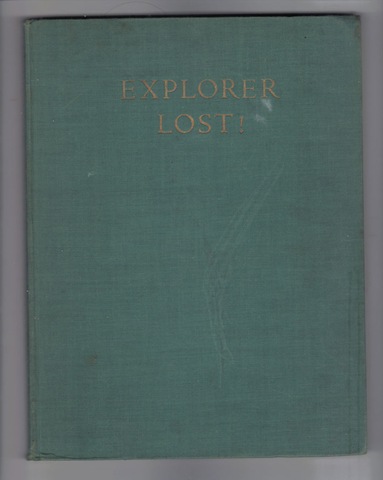
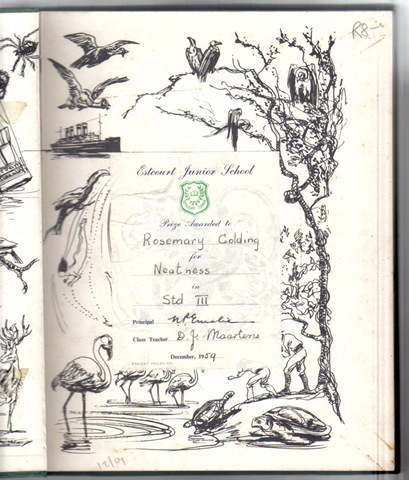
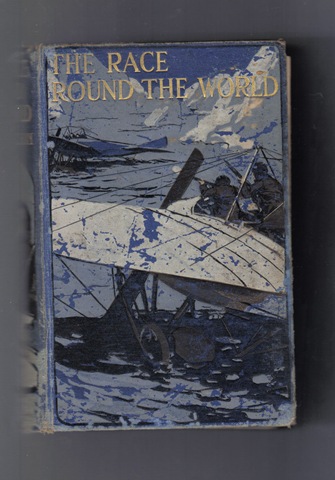
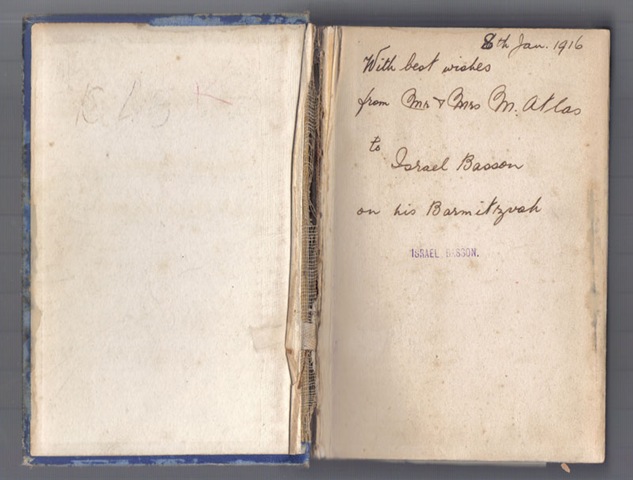
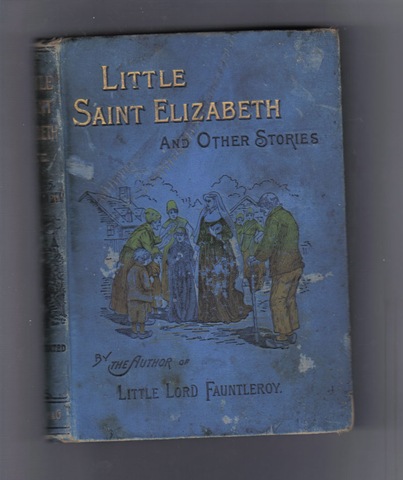
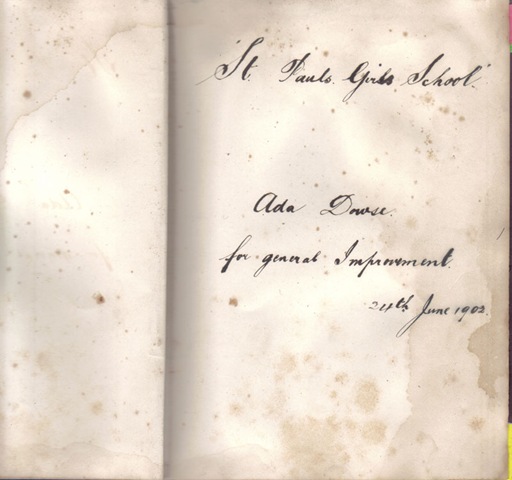
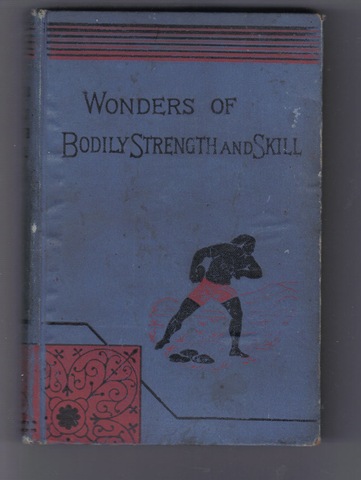
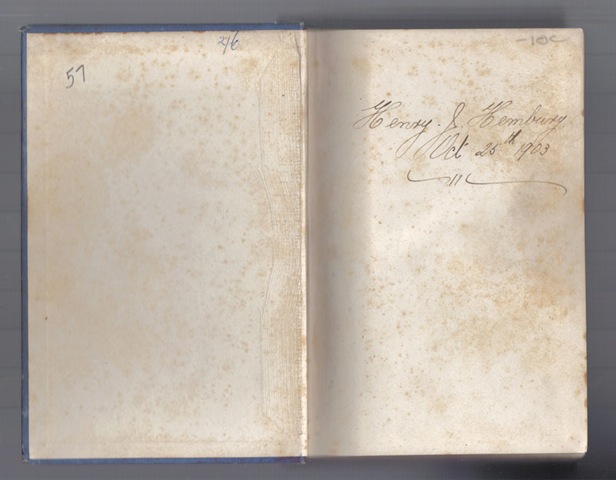
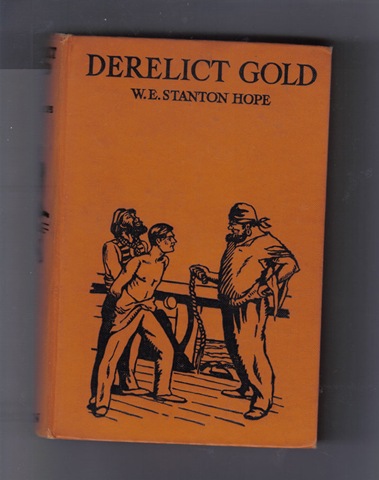
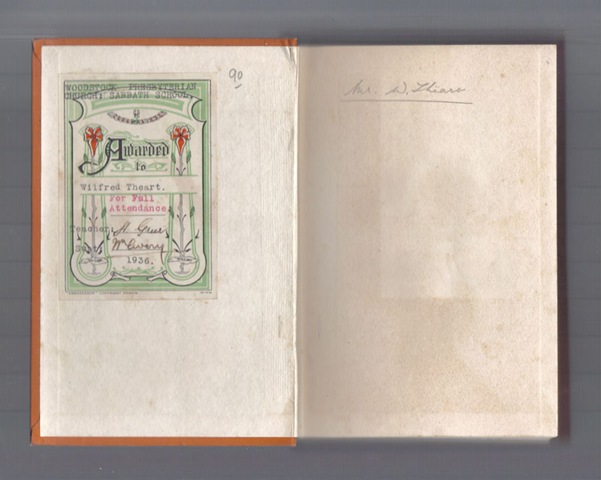
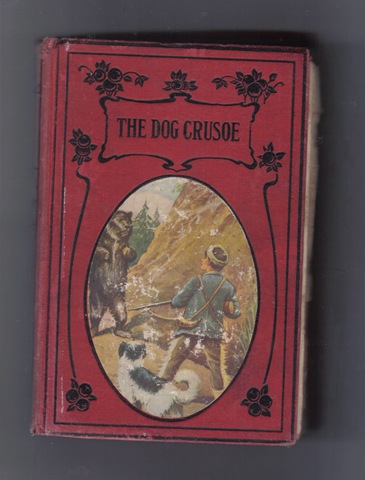
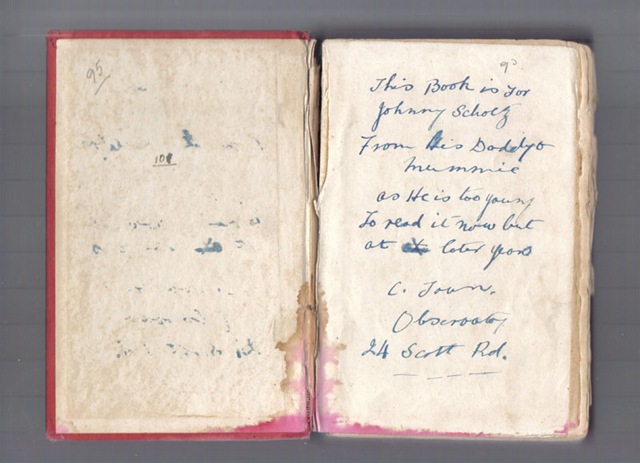
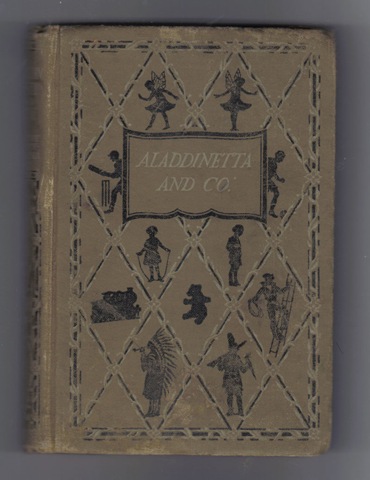
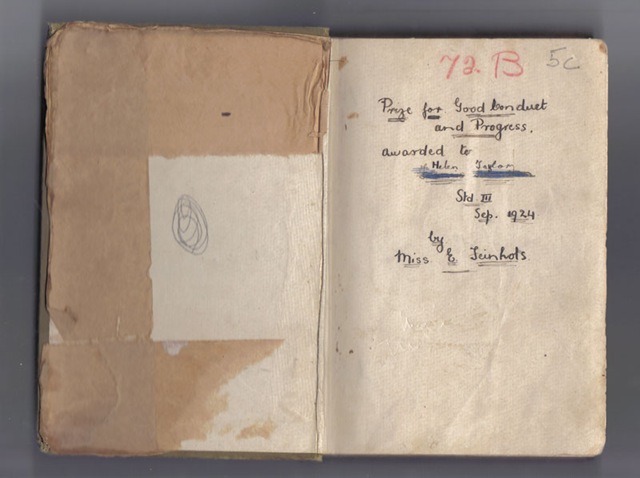
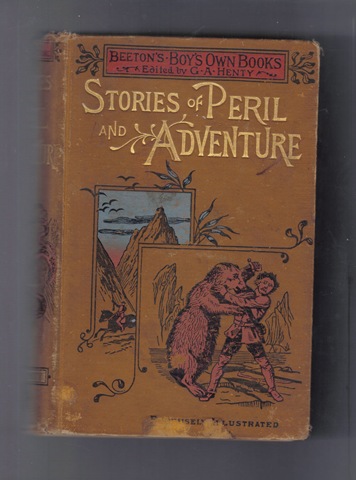
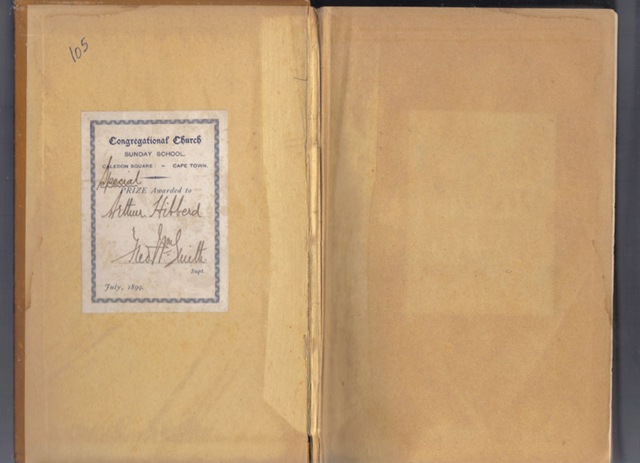
Our latest pastime is poring over those labels glued into endpages and flyleafs that identify those among our vast collection of second hand books that are school prizes for neatness or regular attendance or general excellence. Sometimes, the titles chosen as prizes are apt but sometimes they are a wonderful mismatch!

Open each cover to see what’s flying on the flyleaf…

image-72-blog-2    image-73-blog-2

 image 74 blog 2 image-75-blog-2

image-76-blog-2  image-77-blog-2

image-78-blog-2 image-79-blog-2

image-80-blog-2 image-81-blog-2

image-82-blog-2 image-83-blog-2

image-84-blog-2 image-85-blog-2

image-86-blog-2 image-87-blog-2

Book words that take my fancy

Flyleaf the first or last page of a book that is next to the cover and has nothing printed on it.

Frontispiece a picture at the beginning of a book on the page opposite the title page

Bookplate a piece of paper with your name on it that you stick inside the front of a book that you own

Front matter the information at the beginning of the book before the main part starts

Recto a page on the right side of an open book

Verso a page on the left side of an open book

Posted in Uncategorized | Leave a comment

Whose story is it anyway?

This is an old story, an issue that won’t go away.

At a recent IBBY bookbash very kindly hosted by Tanya Barben at the Rare Book Collection at the UCT library, a splendid array of books was laid before us: African folk tales ranging in form from current picture books to old collections, with everything in between; some beautifully illustrated, some not; some colonial in tone, some as politically correct as you can get. Tanya had been spurred to get this particular event together as a response to comments made on a previous occasion about the unsuitability of many African tales because of their goriness and their portrayal of stereotypical gender roles. She effectively countered this by relating the grim and gory plot of a European traditional fairy tale (by Grimm?). “A hit with most kids I know,” I thought to myself, but that was not the issue that was making me feel uncomfortable.  I looked around at the group of 8 or 10 of us, the usual suspects at these dos, and then back down on the laden table.  There seemed to be an invitation for the writers, publishers, booksellers and librarians present to view this as a wonderful resource, but especially to the writers to dip their hands into these riches, to dig in and explore and ultimately to refashion them into more books:  retellings of retellings or brand new stories based on a thread discovered here and there. The prospect was delicious.

So, what was it that was bothering me?

I suppose that old South African issue of ownership. These stories are some of the richest products of certain cultures, for the Khoi – San or Bushmen, products of the Homers and Shakespeares of their society. Was it ethical for me to take anything that took my fancy and use it in whatever way I want?

On the one hand there is the basic tenet of artistic freedom – the right (and necessity!) of fully inhabiting any character that takes an author’s fancy and expressing his/her feelings in whatever way she finds interesting. On the other hand, even artists must accept limitations to their freedom: we are not allowed to copy verbatim other artist’s work – that is plagiarism; there are unsaid rules that we adopt to avoid material inappropriate to children – pornographic content or suchlike. So why do we find it difficult to understand that before diving into Tanya’s books for a story or for inspiration, we need to ask ourselves what right we have over the material.

I have many questions and I’m not sure where I stand on them. I definitely do not want to take the moral high ground in this debate for over my career I have most probably been as guilty as most in wandering into this ethical bog.

When we retell the stories of Norse mythology, for instance, we are writing about a people that no longer exist, but this is not the case when we retell the stories of the Bushmen/ khoi-San. Should we take into the equation the current lives of the remaining Bushmen? On the whole they live in abject poverty. These stories are undeniably their valuable and precious heritage. Should they benefit in some way from the publication of their stories?

Is it our duty to chronicle their stories if they show no interest in doing or are unable to do it themselves?

Do we have to earn the right to tell their stories? In what form is the ‘earning’ to be done? Library research? Living alongside the ‘target’ community? Why does it not rankle nearly as much when one hears that the chroniclers actually lived in the community for many years? (Best of all, are members of the community!) Do we then consider the work more authentic? Is this a valid distinction?

What distinguishes our C21 approach to the old colonial mould of collecting stories for children from exotic peoples?

Do we need to be culturally appropriate to the tee or is this a straitjacket on our freedom and the freedom of children- readers?

Is all that matters how well (imaginative, empathetic, gripping etc.) we do the job? One of our members offered her take on the matter by emphasizing the universal child as the main character and the main recipient of our stories. To highlight quality and universalism goes some way to bridging cultural divides but does it adequately address the issue of the ethics of appropriating cultural treasures?

These are some of the questions that circled my head as I left the Bookbash. What do you think?

Posted in Uncategorized | Leave a comment