
I need to remind myself every day to BE BOLD.
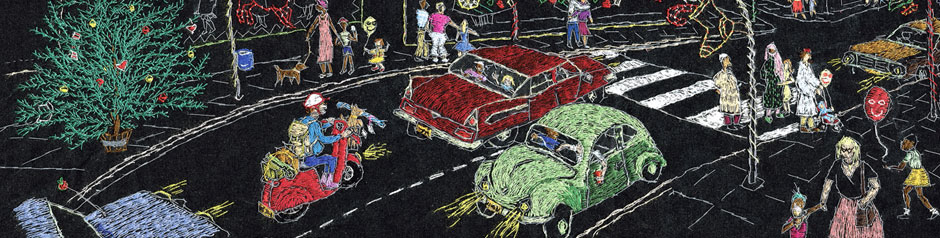
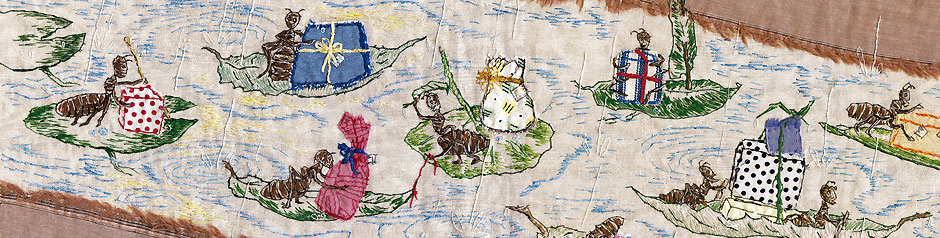
From: ‘Am I a lion that eats people?’ 2004 ELRU publication about HIV/Aids
photographs by Enver Essop with painted elements by Reviva Schermbrucker
I need to remind myself every day to BE BOLD.
From: ‘Am I a lion that eats people?’ 2004 ELRU publication about HIV/Aids
photographs by Enver Essop with painted elements by Reviva Schermbrucker
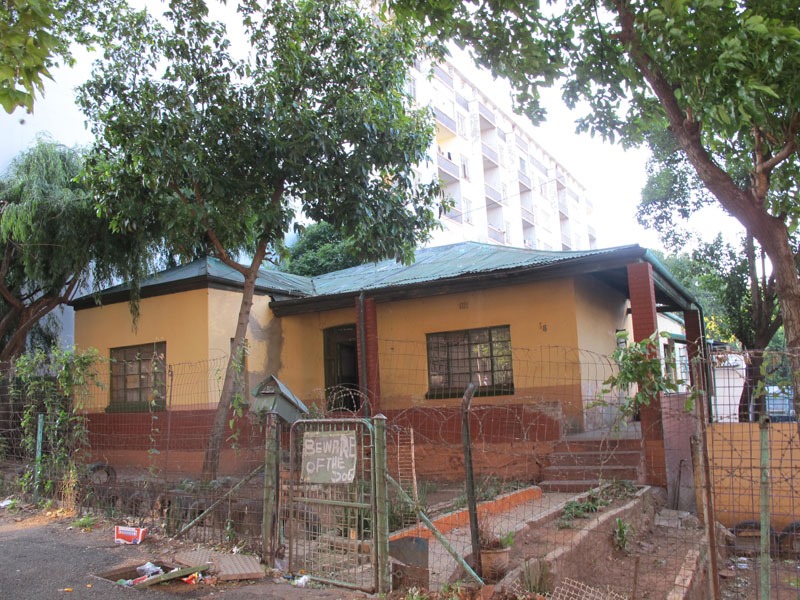
The houses we sequentially lived in and rented in my under-teens were all in Yeoville; their street names rhyme with an internal GPS, coordinates that hit solid bodies in my galaxy, sounding off resonating booms and squeaks through space and time: Yeo, Minor, Page, Percy…
This house on Percy Street (photographed about 6 years ago) is the very home that was ours when my mother brought back from the hospital the tiny parcel that was my baby brother. I was 9 years old and he would be and remains 9 years younger than me to this day. This fact created one of those strong patterns I consoled myself with – like the backbone of a cooked fish – bringing a preordained order to a daily life which flaked apart in a dreamy daze. He was slightly premature and the cord had been wrapped around his neck – I remember the words being said – which imparted to the tiny morsel around which everybody clustered, the first male offspring, a certain gravitas. Like a hangman.
The bris was held in the house. There is a photograph of mother, father, granny (Saphta) sister and me on a bench in the garden adjoining the house (off to the right of the photo) at the event. Strangely no baby brother. Behind the bench is the Catawba grapevine on which my sister and I, in the long days of summer, would graze. The skins of the small black berries we picked were clouded in a white film, sticky from insect damage or glued with spider webs. The skins were tough and sour, the insides perfumed and sweet. The technique for eating was best encapsulated in the Afrikaans “druk en sluk’, press and swallow.
Above the house loomed (looms) a block of flats from which naughty boys would rain down stones on our roof. My father’s reaction was to run outside, shouting and shaking his fist up in the sky hammering the air in impotent fury. For a while the stones would stop.
My sister and I shared a bedroom and it is this feature that I remember best: twin beds covered in lilac self patterned bedspreads made of a popular cloth of the time – Waffleweave. The texture – a grid of squares, paddocks fenced with soft fringes – provided comfort and order in the same way that colouring-in books with sturdy black outlines contained my wax crayon strokes. This was despite a mother who did not approve of colouring-in books which she said blunted her children’s natural creativity.
Walls and roofs do not only shelter people, they create shapes that attach to their very being, as real as bones in flesh.
In a debate where children, publishers, librarians and writers sat in a circle to discuss what it is we should be writing/publishing for children, I found myself the lone voice against writers taking too much note about what children had to say about what they wanted to read ( not unexpectedly, soccer, gore and violence for boys and romance with happy endings for girls).
Was this the stance of an arrogant, selfish writer who always knows better, who asserts her own rights and interests above the children she writes for? Is largely dismissing what the children said a sign of being “out of touch”?
I do not think so.
Asking children what they like only scratches the surface. Very few children, if any, can express what they are about in a meaningful way ( Few adults can, either!) As authors we respond to what we know is there below, our common humanity, as yet undeveloped, latent even, but requiring the most skilful teasing to bring it gently to the child’s attention – the job of the writer.
Children are indiscriminate consumers. They are surrounded by cultural products which have shaped their opinions well before we get our hands on them. Other adults have stuffed them on a diet to which they have become addicted in the form of media, advertising, TV etc. They cannot express what it is that innately interests them but rather reflect what is already out there. How can one assert that the children have chosen freely when they are not even aware of the possibilities that lie outside the uber sex-streamed range of which the children who attended the meeting made mention? It is the task of authors to grow children’s minds by getting them to fall in love with what they could not choose because they did not know it existed before they were exposed to it. The role of the adult, be it parent, teacher or librarian is crucial in introducing to children possibilities that they would not necessarily choose off their own bat.
It would take an extremely brave and sussed child to ask for a book to be written about a gay older brother but expose a child who is working on these issues on some unconscious level and you begin to make a difference. Write a book that is consciously aimed to hit the boy spot with violence/gore or girl spot with romance and syrupy endings and you are very likely to miss the spot completely, miss the opportunity, miss the point of literature. Yes, that big word, literature.
Does this mean that books should be educational, serious, boring, didactic, dull, teachy-preachy, lack humour? On the contrary! Our books should be hilariously funny, spine-chillingly creepy, deeply profound, culture-authentic to a tee, blanket-comforting, exciting, exciting, exciting (If not all these things in one book, at least some!). No author worth their salt should aim for anything less than this. That has to do with bringing all of what we have – our skill, imagination, humanity, insight – to bear on what we do even if we are writing a 3 word a page story about a rat in a trap.
As a parent one knows not to cave in to a diet of ice cream and sweets because one recognises that this is not what the child really wants (and is clearly not good for her). Similarly, while the expressed desires of our readership is useful – the act of asking children their opinion is enormously important in the development of their own self-understanding – we should remain cheerfully sceptical about the nuts and bolts of what they tell us.
Does this mean that there is no place for comfortable, predictable reads – those series that children love ? Of course, there is and should be. However, I feel that we have an opportunity, whatever the genre we write, to bring to the light of print underneath a child’s eye a whole lot more than what they simply tell us they want.
Let me repeat: children are indiscriminate consumers. Ask the average 7 year old to choose which illustrations they like best from an array of picture books and most children will choose the worst: treacly Disney caricatures or suchlike in line with what they see on the box. It is the responsibility of publishers to put the highest quality illustrations in our books to lead children into the pleasures of engaging with the very best and slowly build in children the ability to discriminate.
This is not a plea to maintain a cosy, middle class status quo. It is even more important in poorer and more deprived areas that the books we create are simply gorgeous – both visually and story-wise. Where there is little, they can shine and attract.
Getting children to read at all costs is a slippery slope…
Do not short-change our children.

Bredasdorp, right next door to Elim Butchery. Price? R25 each.
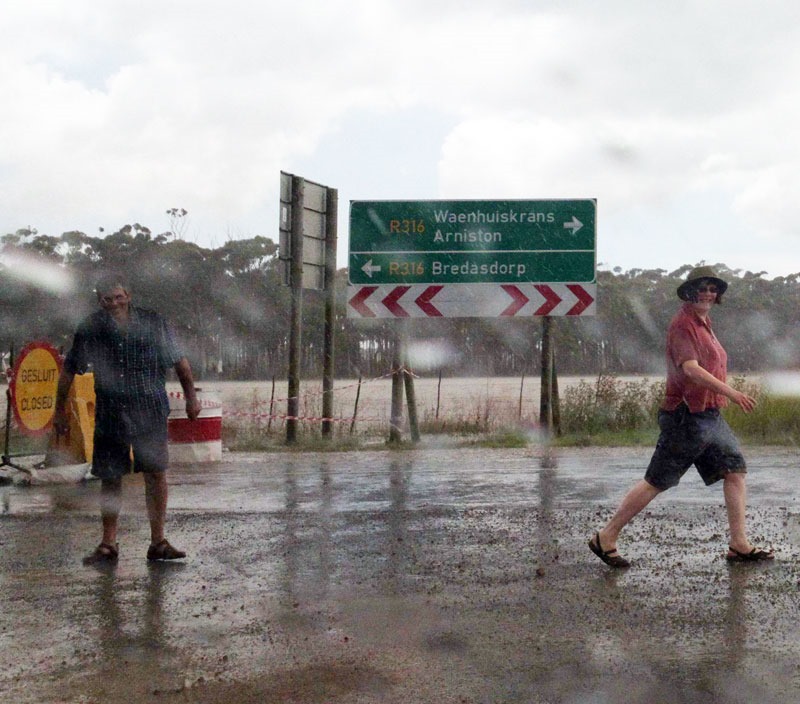
photo: Sue Kramer
When the bridge flooded between Arniston and Bredasdorp everybody drove out to have a look. Sheets of water lay on the dry scrubby renosterveld on all sides creating unlikely vistas of endless lakes. Puffadders (dead) lay strewn on the margins of the flooded road. Their offspring and frogs (alive) swam through the brown muddy water that streamed across it. Children played on rafts wading waist deep in the brown water in what was once fields. They screeched with excitement at the imaginary and real monsters lurking in the opaque water. Cars bravely tested the water levels before reversing out in a hurry. The heavens opened up and gave the jubilant congregation more water in which to revel. All good fun except perhaps for the farmer who had to clean up and fix fences when the water abated after three or four days.
Here we are heading in different directions. An amicable split? No, merely joyously drenched.

In the compost heap of the imagination, a novel is slowly emerging…

S.S. Florence Brierley arriving in Cape Town 1950

S.T. Florence Brierley at sea 1951
These two darling oil paintings, the artist of which is only identified by the name “Leo”, are now ours.
Internet gives us a few dry facts on the Florence Brierley but I want to know who Leo is and some meaty stuff on the ship itself. Anybody out there who sailed on the Florence Brierley?
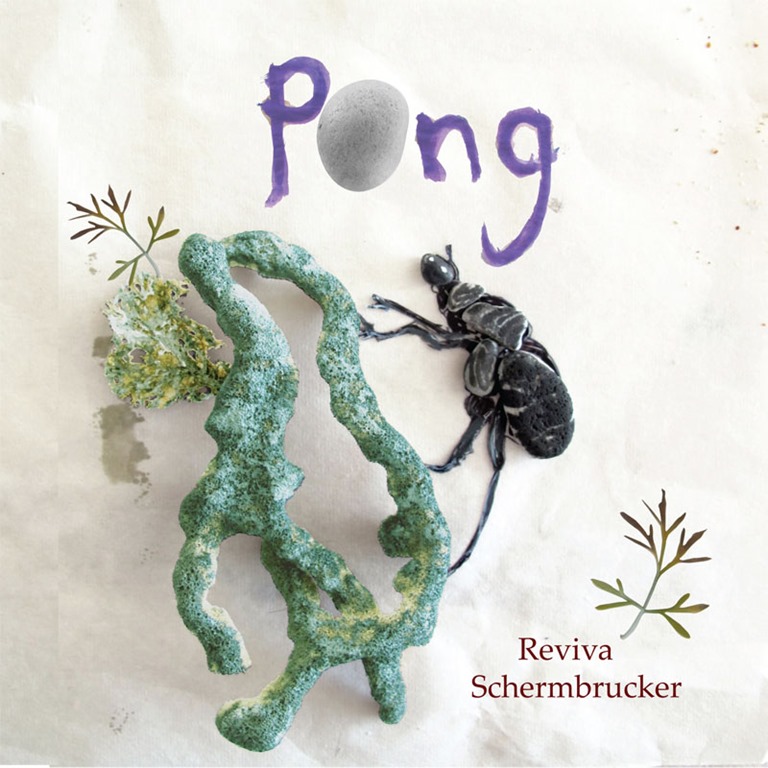
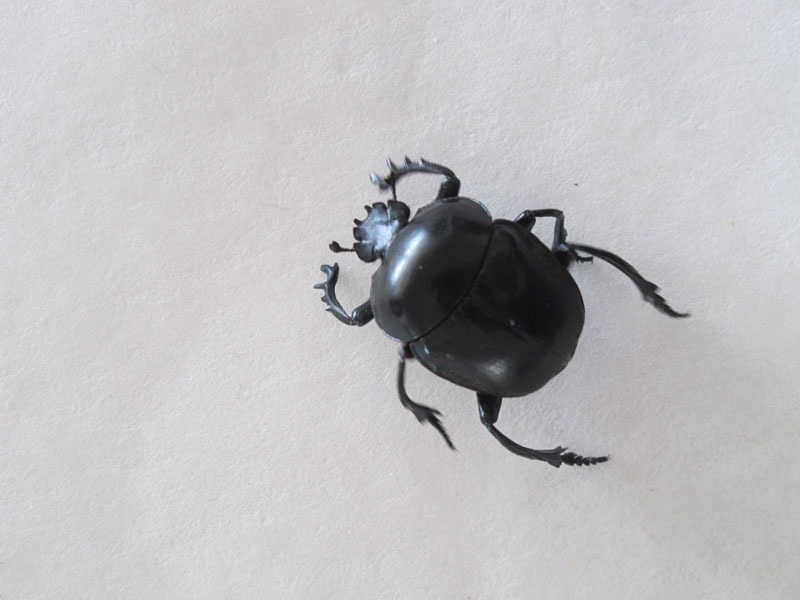
It’s not often that real live models insist on visiting people visualising them for the sake of a book but that is what happened when I was busy illustrating a story about a dung beetle using the usual 2D source material for reference. The story is a (lyrical?) exposition of the extraordinary discovery that dung beetles navigate using the stars.
“Look what I found at your front gate,” a friend said, tipping a real life dung beetle onto my work space. Pong – for that is the name of the character in my book, its title and by instant association, the visitor – went into tortoise mode, hiding under his shiny black carapace.
What brought Pong to our gate, I wondered? Was it my lucky stars? Had to be.
Here is Pong, the book and Pong, the visitor and model. ( Yes, I set him free two days later leaving him outside the gate to carry on to where he might have been heading.)

In a week where there was one big death, there was another that did not get a trillionth of the attention but was big for us. Mavis Mogotsi, grandmother to Charlie Tankie Mogotsi and mother to Christine Mogotsi, was a fiesty individual, full of garrulous warmth and quick to share her opinions based on broad, old-fashioned values. Inside her small, sinewy frame was an even tougher rod of steel.
In the book Charlie’s House she plays a small role but in the real lives of Christine and Charlie she was huge. She will be sorely missed by them.
Hamba Kahle, Mama.
This photograph was taken in 2011 when we visited the family in their new home in Kimberley.
Everybody has a version of Madiba that is their own. This is mine.

Hamba Kahle, Tata
from The Jam Tin and the Teacup, Songololo Books 2002